Emotion Is the Weapon. The Story Is the War. Are You Writing Yours?
Plato said it over two thousand years ago:
“Those who tell the stories rule society.”
He was not talking about entertainment. He was not talking about marketing. He was talking about power — the oldest and most effective form of it. The kind that does not require force because it never needs to. It just needs you to feel the right thing at the right moment.
And here is the part that should stop you cold:
Most of the time, you do not even know it is happening.
What You Remember — and Why It Matters
Think back to a difficult period in your life. A stretch that felt heavy — stressful, uncertain, overwhelming. Maybe a year in business that felt like constant crisis. A season in a relationship where the tension never fully broke. A time when everything felt harder than it should have.
Now ask yourself: how much of the specific detail do you actually remember?
Not much. You do not remember most of the facts. You do not remember the individual days or the specific conversations or the precise sequence of events.
What you remember is the feeling.
The tension. The anxiety. The weight of it. That emotional residue is what your brain stored — because that is how memory actually works. Emotion shapes perception. Perception shapes memory. And your memory — the story you carry about what happened and what it means — determines every decision you make going forward.
This is not a flaw in human design. It is a feature. And in the wrong hands, it is a weapon.
The Emotional Architecture Phenomenon
In Human Performance Mastery, we call this the Emotional Architecture Phenomenon — the deliberate use of emotion to construct a reality in someone’s mind that serves someone else’s agenda.
It is not new. It has been used by religious institutions, revolutionary leaders, kings and empires throughout history. Emotional storytelling has always been the most efficient tool for moving large groups of people in a specific direction.
What is new is the speed.
Stories used to move through villages. A rumor, a narrative, a carefully constructed emotional experience would take days or weeks to spread. Today it takes seconds. A single video clip. A single sentence on social media. A single manipulated headline — and millions of people are riding a wave of emotion before they have had a single moment to think clearly about what they just consumed.
As Mark Twain put it — a lie can travel halfway around the world while the truth is still putting on its shoes.
We are living in a moment where emotional reaction has completely replaced critical reflection for most people. Where the speed of the trigger has outpaced the capacity to pause and evaluate. Where the story arrives already loaded with the feeling it wants you to attach to it.
If you can make people feel stressed, unsafe, and uncertain — you can anchor those feelings to a person, a product, a political party, an idea. And from that moment forward, when they encounter that person or idea, the body responds before the mind even engages. The decision is already made. At the emotional level. By someone else.
The High Performer’s Blind Spot
Alpha Achievers are not immune to this. In fact, in some ways they are more vulnerable — because they are high-information consumers. They read more, consume more, engage more. Which means more exposure to more carefully engineered emotional narratives.
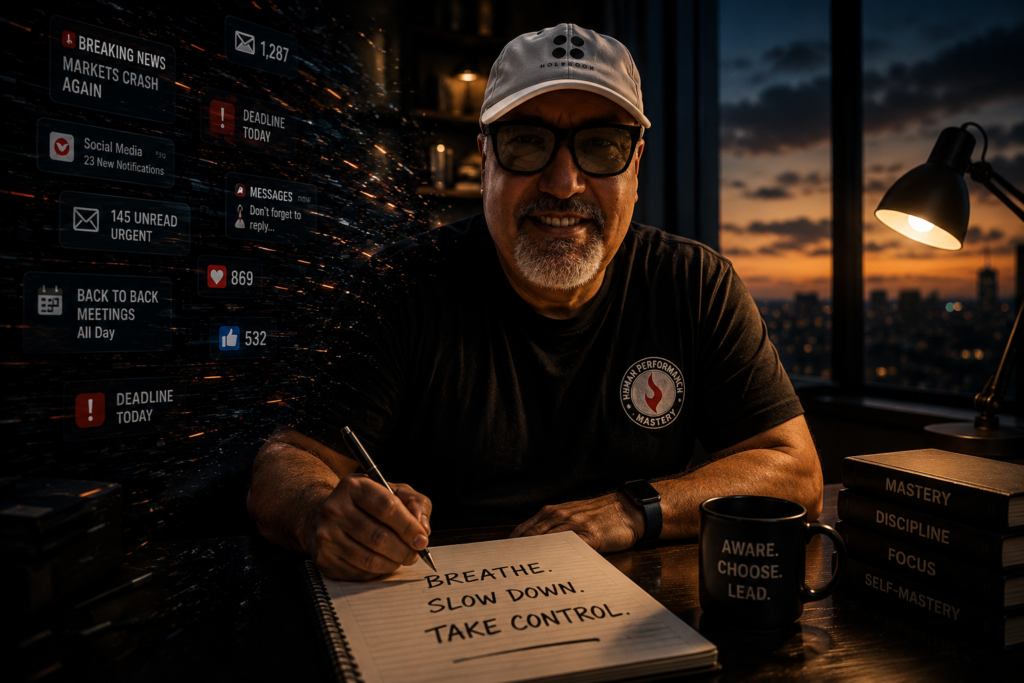
The question is not whether you are being targeted by emotional storytelling. You are. Everyone is. Every day.
The question is: are you reacting — or are you responding?
Reacting means the emotion arrived, attached itself to a narrative, and produced a decision before your conscious mind had a seat at the table. You felt it. You believed it. You moved based on it.
Responding means something different. It means you noticed the emotion. You got curious about it — where it came from, who constructed the story that triggered it, and what they needed you to believe in order for that feeling to land. It means you stayed neutral long enough to understand what was actually happening rather than simply feeling what you were being told to feel.
That is not cynicism. That is consciousness. And there is a significant difference between the two.
Own Your Story — Or Be Owned by Someone Else’s
Here is the hard truth: if you do not consciously write your own story, someone else will do it for you.
And I can promise you this — they are not writing it with your best life in mind.
The antidote is not disengagement. Checking out, going dark, refusing to participate — that is not mastery. That is avoidance dressed up as wisdom.
Real mastery is staying fully engaged while choosing your response with intention. It means practicing three specific shifts every time you feel a strong emotional pull from a story being told around you:
Awareness over Bias. Before you accept a narrative, ask: what do I already believe that makes this feel true? Are you evaluating evidence — or confirming what you were already emotionally primed to believe?
Curiosity over Outrage. Outrage closes the mind. Curiosity opens it. When something makes you immediately angry or afraid, that is precisely the moment to slow down — not speed up.
Consideration over Assumption. What are you not seeing? What part of this story is being deliberately left out? Who benefits from the emotion this narrative produces in you?
These three practices do not make you passive. They make you precise. They return authorship of your internal state — and therefore your decisions, your relationships, your performance — back to you.
The War Is Already Happening
The war being waged for your attention, your emotion, and your narrative is real and it is constant. It does not take a break on weekends. It does not respect your boundaries or your goals or the life you are trying to build.
But here is what Plato also understood: the person who tells their own story — consciously, deliberately, from a place of clarity and self-knowledge — cannot be ruled by someone else’s.
Write your story. Lead your emotion. Choose your response.
Or watch as someone far less invested in your success writes it for you.
The Pillar Behind This
This is Pillar 04 — Self-Mastery. You cannot master your business, your leadership, or your relationships until you master the one thing that sits beneath all of them — your own narrative. The story you carry about who you are, what happened to you, and what is possible for you determines everything that follows.
Who is writing your story right now — you or someone else? TalkWithMartin.com — No warmup. No small talk. 30 minutes to the truth.