The 6 Ways Humans Process Emotions & Decisions
Why Smart People Still Miscommunicate, Stall Out, and Struggle Under Pressure
Most people believe communication problems come from a lack of intelligence, clarity, or motivation.
But after years of coaching executives, athletes, business owners, entrepreneurs, and high performers, I’ve found something deeper:
People are often running completely different internal processing systems.
Two intelligent people can experience the exact same conversation, challenge, or opportunity… and process it in completely opposite ways.
One person needs to FEEL before they move.
Another needs to THINK before they trust.
Another needs to ACT before clarity shows up.
And when people don’t understand these internal sequences, communication breaks down.
Leadership weakens.
Conflict escalates.
Teams disconnect.
Relationships suffer.
And performance becomes inconsistent.
The truth is:
Most people are not difficult.
Most people are simply processing differently than you.
The Three Core Human Functions
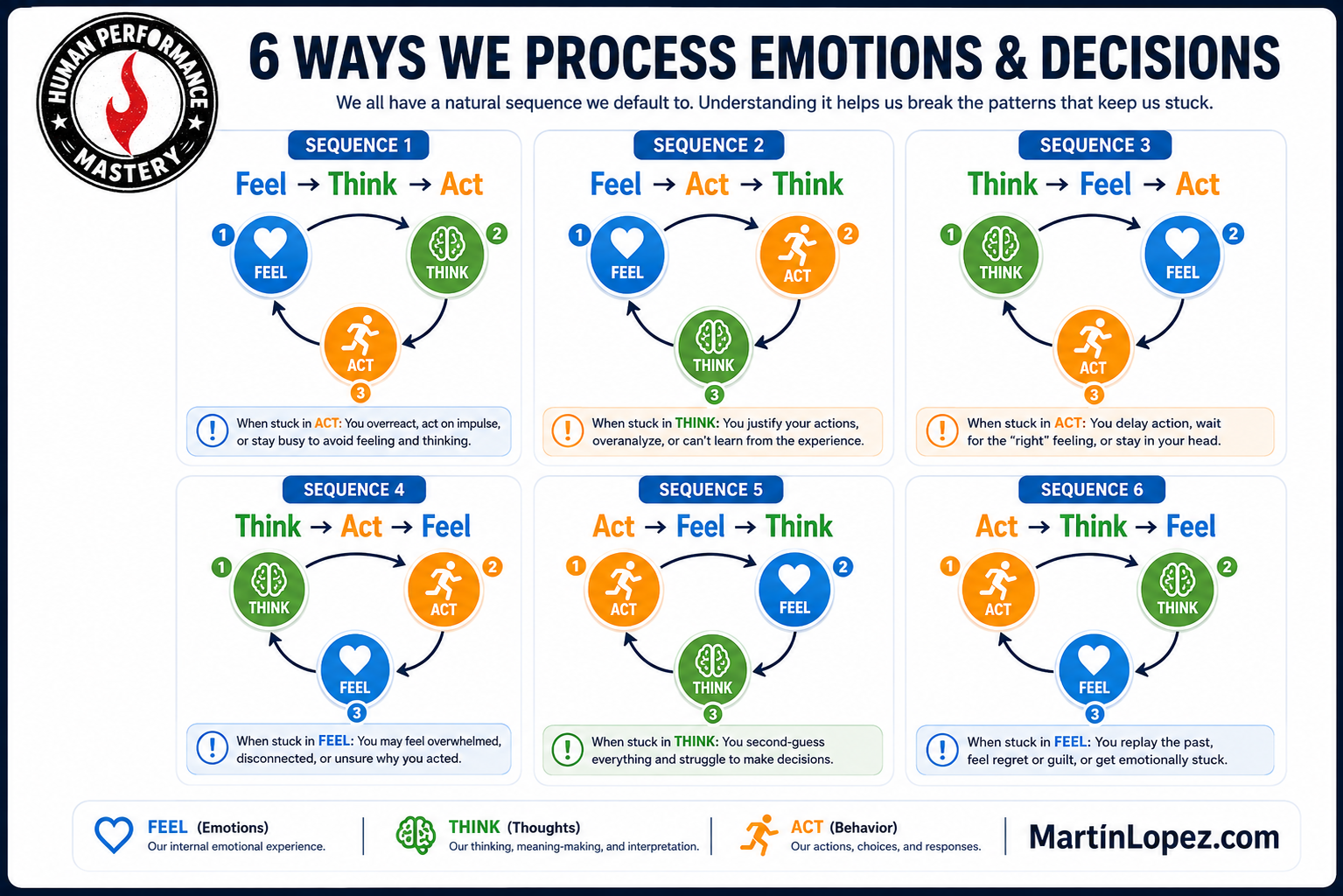
At the foundation of human behavior are three core functions:
- Feel (Emotions)
- Think (Thoughts & Meaning)
- Act (Behavior & Decisions)
Every human being uses all three.
But the order matters.
That sequence changes:
- how people communicate
- how they make decisions
- how they handle pressure
- how they experience conflict
- how they process feedback
- how they build trust
- how they recover from mistakes
And most importantly:
The final step in someone’s sequence often becomes the place they get stuck.
That stuck point becomes the hidden bottleneck in their leadership, business, and life.
Sequence 1: Feel → Think → Act
These individuals feel first.
Emotion enters the system before logic.
They experience tension, excitement, fear, inspiration, frustration, or connection first… then begin trying to understand what it means.
After processing emotionally and mentally, they act.
These people are often:
- relational
- intuitive
- emotionally aware
- empathetic
- people-focused
But here’s the challenge:
When they get stuck in ACT, they may:
- procrastinate
- avoid hard decisions
- stay “busy” instead of decisive
- emotionally spiral
- overreact impulsively
In leadership, this can look like:
- delaying difficult conversations
- struggling to enforce standards
- people-pleasing
- inconsistent execution
The danger is not emotion itself.
The danger is unprocessed emotion controlling action.
Sequence 2: Feel → Act → Think
These people feel something and immediately move.
Action becomes emotional release.
They tend to:
- trust instinct
- move fast
- react quickly
- take initiative
- rely on momentum
These individuals can be highly entrepreneurial and highly competitive.
But when stuck in THINK, they may:
- justify poor decisions
- rationalize emotional reactions
- avoid accountability
- struggle learning from mistakes
- create stories to protect identity
In business, this can sound like:
- “That’s just who I am.”
- “I had no choice.”
- “People don’t understand me.”
- “I already know.”
They move before reflection.
And without reflection, growth stalls.
Sequence 3: Think → Feel → Act
This is one of the most common executive processing patterns.
These people think first.
They analyze before emotionally committing.
Logic creates emotional safety.
Once they feel certainty or alignment, they act.
These individuals are often:
- analytical
- strategic
- intelligent
- measured
- thoughtful
- prepared
But when stuck in ACT, they:
- overanalyze
- wait too long
- hesitate
- seek certainty
- struggle taking risks
This creates what I call:
“Intelligent paralysis.”
They know.
They understand.
They plan.
But execution gets delayed because they’re waiting for complete clarity.
In leadership, this creates:
- slow decisions
- missed opportunities
- team frustration
- lack of adaptability
- fear of failure hidden behind perfectionism
The mind becomes a waiting room.
Sequence 4: Think → Act → Feel
These individuals think strategically and then move quickly.
Feelings often arrive after the action.
This pattern is common among:
- high-level leaders
- military personalities
- executives
- entrepreneurs
- high performers under pressure
These are often the people others describe as:
- decisive
- strong
- logical
- disciplined
- composed
But here’s the hidden cost:
When stuck in FEEL, they may:
- disconnect emotionally
- suppress emotions
- feel numb
- suddenly burn out
- become reactive later
- not understand why they feel empty despite success
This is the leader who wins externally while quietly collapsing internally.
Their system was trained to perform…
but not always to process.
Over time, emotional suppression becomes emotional debt.
And eventually, the nervous system collects.
Sequence 5: Act → Feel → Think
These people discover through movement.
Action creates emotion.
Emotion creates reflection.
These individuals often:
- learn by doing
- experiment naturally
- move toward experience
- dislike overthinking
- adapt quickly
These are often creators, entrepreneurs, athletes, and experiential learners.
But when stuck in THINK, they may:
- second-guess themselves
- mentally replay everything
- lose confidence
- become indecisive after action
- overcomplicate simple choices
The challenge becomes:
They trust themselves while moving…
but lose themselves when thinking too long afterward.
This can create emotional inconsistency and self-doubt.
Sequence 6: Act → Think → Feel
These people move first, analyze second, and emotionally process last.
This pattern is extremely common in:
- elite performers
- competitive personalities
- sales professionals
- entrepreneurs
- high-output achievers
Action becomes identity.
Movement becomes control.
Results become emotional validation.
These individuals can accomplish extraordinary things.
But when stuck in FEEL, they may:
- replay failure endlessly
- carry guilt
- struggle slowing down
- feel emotionally disconnected
- experience delayed emotional crashes
This is often the person who looks strong publicly…
but privately feels exhausted, empty, or emotionally trapped.
They know how to perform.
But they may not know how to emotionally recover.
And without recovery, performance eventually becomes survival.
Why This Matters in Business
This framework changes the way you lead people.
Because now you stop assuming:
“If they understood what I understand, they’d respond like me.”
That assumption destroys communication.
A Think-first leader may overwhelm a Feel-first employee with logic.
An Act-first entrepreneur may frustrate a Think-first operations manager.
A Feel-first client may need emotional certainty before buying.
A Think-first partner may need clarity before connection.
Everyone is processing reality differently.
And the best communicators understand the sequence before trying to force the solution.
Leadership Is Emotional Translation
The greatest leaders are not simply strategic.
They are translators.
They recognize:
- how people process pressure
- how they create meaning
- how they emotionally protect themselves
- how they move through uncertainty
That awareness changes:
- coaching
- sales
- conflict resolution
- team dynamics
- hiring
- culture
- parenting
- relationships
- negotiation
- emotional resilience
The goal is not to judge someone’s sequence.
The goal is to understand it.
Because awareness creates adaptability.
And adaptability creates influence.
High Performance Requires More Than Strategy
Most people focus only on:
- systems
- tactics
- goals
- execution
- productivity
But eventually every human being runs into themselves.
Their emotions.
Their nervous system.
Their identity.
Their patterns.
Their conditioning.
That’s why two equally talented people can produce completely different results under pressure.
One understands their internal operating system.
The other is unconsciously trapped inside it.
The future of leadership is not just intelligence.
It’s self-awareness.
It’s emotional agility.
It’s understanding how humans actually process reality.
Because once you understand the sequence…
you stop fighting people.
And you start leading them.
— Martín Lopez
Human Performance Coach
The Curiosity Theory
MartinLopez.com