Emotional Fitness Is the New Alpha Skillset — And Nobody Is Teaching It
You can be jacked. You can be rich. You can be the smartest person in every room you walk into.
But if you cannot regulate your emotional state under pressure — you are a liability. To your team. To your relationships. To yourself.
That is not an opinion. That is what I have watched happen to some of the most talented, accomplished men I have ever coached. And it is the one variable nobody is talking about seriously at the level it deserves.
The Skill That Separates Amateurs from Alphas
Your brain does not grow through information. It grows through experience plus reflection.
You have read the books. You have been to the seminars. You have consumed more content about performance and leadership than most people will in a lifetime. And still — when the pressure spikes, when the deal goes sideways, when your spouse says the wrong thing at the wrong moment — something takes over.
That something is emotional fragility. And it is not a character flaw. It is an untrained muscle.
Emotional fitness is not a soft concept dressed up in performance language. It is a genuine skillset — one that determines whether you lead the moment or get led by it. In every high-stakes situation you will ever face, emotional control is the advantage. The person who can stay clear, stay present, and respond from intention while everyone else is reacting from instinct — that person wins. Every time.
You were not born to explode when things go wrong. You were not born to shut down when your world gets loud. You were born to channel — to take the raw force of what you feel and direct it with precision toward the outcome you actually want.
That is what emotional fitness makes possible. And it is a skill. Which means it can be trained.
Your Emotions Are Data
Here is the reframe that changes everything for the men I work with:
Your emotions are not the enemy. They are not weakness. They are not something to suppress or power through or meditate away.
They are data.
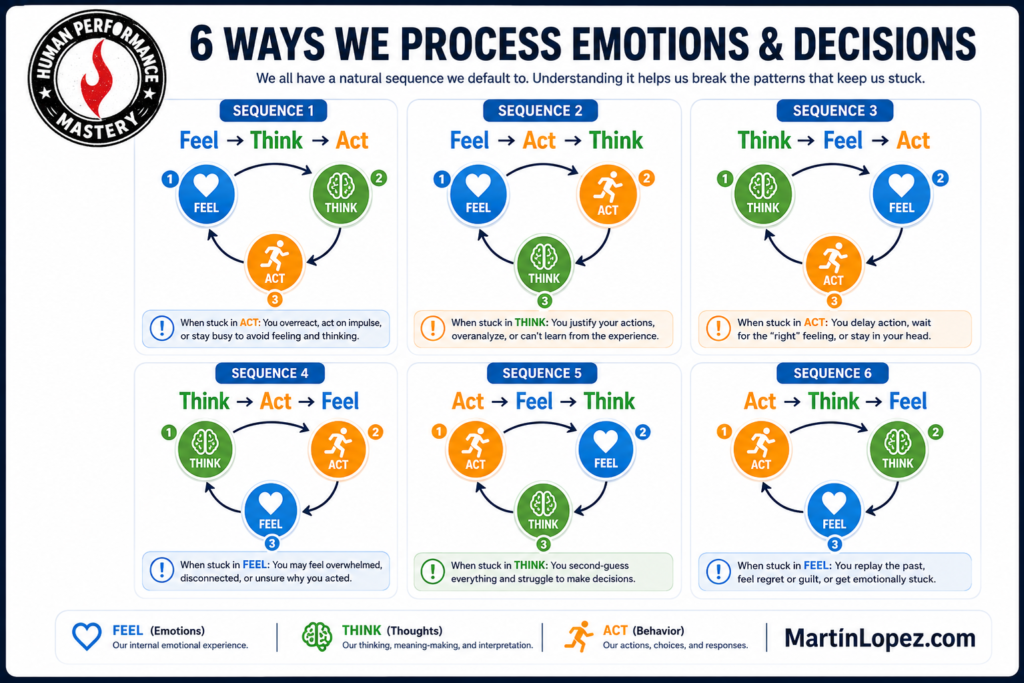
Every emotion you feel has two jobs. First — direction. It is telling you something about what is happening inside you. Second — energy. It is fueling the action you take in response.
Anger is data. It is telling you a boundary has been crossed or a value has been violated. Anxiety is data. It is pointing to uncertainty that needs to be addressed. Frustration is data. It is signaling that something feels out of alignment with where you are trying to go.
The problem is not that you feel these things. The problem is that without emotional fitness, you skip the data entirely and go straight to the reaction. You let the emotion run the moment instead of using it to lead the moment.
The difference between those two outcomes is everything.
The 4-Step Emotional Fitness Loop
This is the framework I use with my clients — from pro athletes to C-suite executives. Four steps. One intentional rep at a time. This is how emotional reactivity gets replaced by emotional leadership.
Step 1 — Trigger: Catch It Early
Most people only notice their emotional state after the explosion. The raised voice. The shutdown. The words said in a meeting that can’t be unsaid.
Elite performers learn to catch the signal before it becomes the reaction. Not just the blow-up — the moment before. The subtle shift in your gut. The slight tightening in your chest. The change in your breathing when a particular tone enters the conversation.
That is your signal. That is the trigger moment. And catching it early is the difference between responding and reacting.
Step 2 — Connect: Get Curious, Not Defensive
The moment you notice the trigger — pause. Not for minutes. For seconds. Long enough to shift from automatic reaction to conscious recognition.
Ask yourself two questions: What am I actually feeling right now? What is this emotion trying to tell me?
You are not labeling the emotion to fix it or dismiss it. You are labeling it to lead it. Because you cannot lead what you cannot name. The second you identify the need underneath the emotion — the boundary, the uncertainty, the misalignment — you have leverage. You have moved from passenger to driver.
This is the moment emotional intelligence becomes emotional power.
Step 3 — Act: Respond from Vision, Not from History
Now you choose. Not react — choose.
Ask yourself: What outcome do I actually want from this moment? What experience do I want to create — for myself and for the people in the room with me?
Anyone can snap. Anyone can shut down. Anyone can let the emotion make the decision for them. That requires zero skill and zero leadership.
A high performer responds with intent. They act from their vision of who they are becoming — not from the conditioning of who they used to be. Instead of reacting from the past, they respond from the future.
That is power meeting precision. That is what it means to lead the moment.
Step 4 — Celebrate: Rewire the Brain
This step is the one most people skip — and it is the one that makes the other three permanent.
Every time you successfully catch the trigger, connect with the data, and act from intention — you acknowledge it. Deliberately. Even for a moment. A mental note. A quiet recognition. This matters.
Here is why: every time you intentionally celebrate a successful emotional rep — even a small one — you reinforce a new neural pathway. You are literally carving a new path through the forest of your nervous system.
The first time you walk that path it is rough. Branches everywhere. No clear trail. But every time you repeat the loop — Trigger, Connect, Act, Celebrate — you clear more brush. You pack down the soil. The path gets easier to find and faster to follow.
What you repeat becomes familiar. What becomes familiar becomes automatic. And what becomes automatic is no longer a fight — it is just who you are.
That is how emotional reactivity gets permanently replaced by emotional leadership. One intentional rep at a time.
Emotional Dominance
The end goal is not emotional management. That is still reactive — it still assumes the emotion is in charge and you are trying to contain it.
The goal is emotional dominance. The state where you feel everything — fully, without suppression — and you direct all of it with purpose. Where the trigger becomes information instead of instruction. Where the pressure reveals your training instead of your history.
That is what separates the alphas from everyone else at the same level of talent, resources, and ambition.
Not who works hardest. Not who knows the most. Not who has the best strategy.
Who can stay clear, stay present, and lead from intention — when everything around them is demanding a reaction.
Train the skill. Build the loop. Become the man in the room that everyone else is trying to keep up with.
The Pillar Behind This
This is Pillar 04 — Self-Mastery. Master yourself before you attempt to master anything else. Your team, your business, your relationships — all of them are downstream of your ability to lead your own emotional state. Fix the source, and everything it feeds gets better automatically.
Ready to train the skill nobody else is teaching? TalkWithMartin.com — No warmup. No small talk. 30 minutes to the truth.