Your Muscles Will Give You Hope: What The Joy of Movement Teaches High Performers
You think exercise is about your body.
Losing the weight. Lowering the blood pressure. Looking good in the mirror. That's the small version.
Kelly McGonigal spent years chasing a bigger question: why does movement make people happier? What she found changes how you should think about every workout, every walk, every morning you get up and move when you don't feel like it.
Here it is in one line:
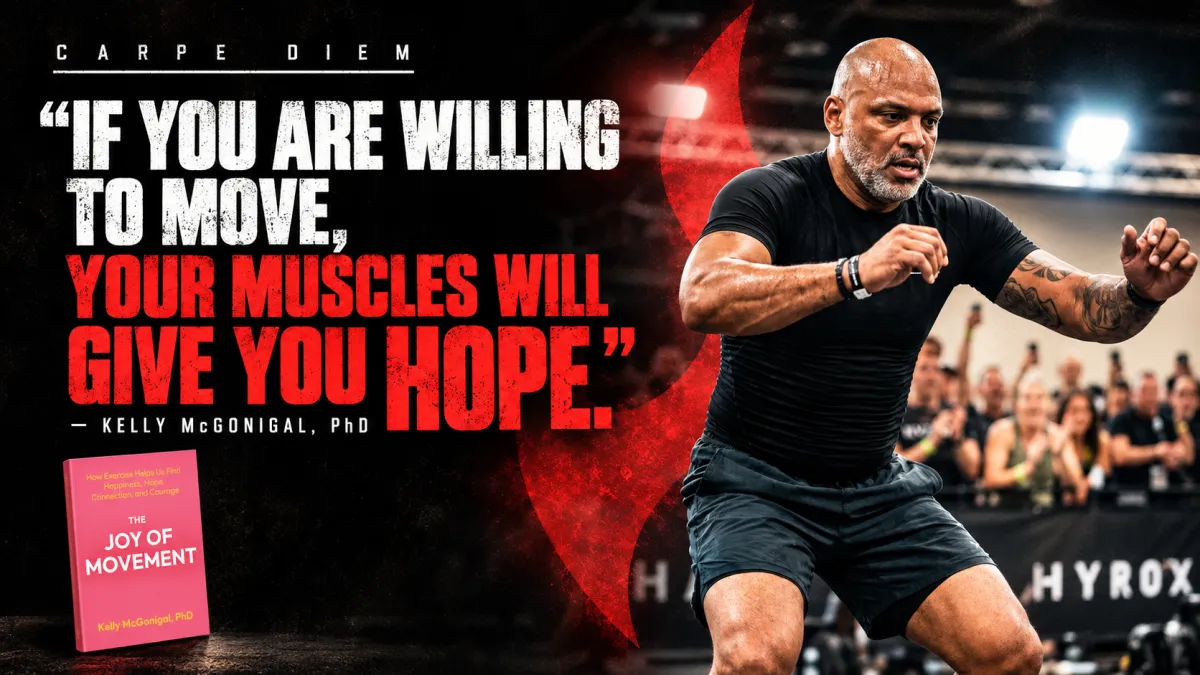
"If you are willing to move, your muscles will give you hope."
That's not a slogan on a gym wall. That's biology.
Who Is Kelly McGonigal, and What Is The Joy of Movement?
Kelly McGonigal, PhD, is a health psychologist and lecturer at Stanford University. You might know her from The Willpower Instinct or The Upside of Stress.
In The Joy of Movement (2019), she skipped the surveys that already prove active people are happier. She went after the why. Neuroscience. Anthropology. Interviews with athletes, friends, and strangers.
And something kept happening. People teared up telling her what movement meant to them. Tears of joy. Her conclusion: the joy of movement is moving.
Her biggest point? The hope, the purpose, the belonging come from movement, not fitness. You don't have to be in shape to get it. You have to move.
Hope Molecules: What Your Muscles Release When You Move
Most people think the feel-good after a workout is just endorphins. McGonigal says that's way too simple.
When you move, your muscles release hormones into your bloodstream that make your brain more resilient to stress. Scientists call them hope molecules. Movement also boosts the brain chemicals that give you energy, ease worry, and help you bond with people.
Over time, regular exercise reshapes your brain to be more open to joy and connection. She says those changes rival the most cutting-edge treatments for depression and addiction.
And here's the part I love. For most of human history, moving wasn't about preventing disease. Moving was how we engaged with life. Your body is built to reward you for showing up.
That's why I keep saying it: energy is the multiplier. Movement is how you make it.
The Persistence High (and the Step Count That Drags You Down)
You've heard of the runner's high. McGonigal says it was never about running. "It's a persistence high."
No pace to hit. No distance to reach. Do something moderately hard for you, stay with it for at least 20 minutes, and your body pays you back for not quitting.
Now flip it. In studies where active adults were made to move less, their well-being dropped fast. They got more anxious, more tired, more hostile. People who cut their daily steps reported a 31 percent drop in life satisfaction within one week.
The step count where that starts? About 5,649 a day. The typical American takes 4,774.
Read that again. The average person is living below the line.
Compare that to the Hadza, a hunter-gatherer community in Tanzania. They average about two hours of moderate to vigorous activity a day. The average American adult gets less than ten minutes.
We Endure Together
Barcelona, 1992 Olympics. British runner Derek Redmond is in the 400-meter semifinal. Fifteen seconds in, his hamstring snaps. He goes down.
Every other runner crosses the line. The race is over. He gets up anyway and starts hopping toward the finish.
Then a man pushes past the officials and runs onto the track. It's his father. They finish together.
McGonigal uses that moment to make a point I live by: we endure best together. "We endure by taking it one step at a time," she writes, and with the help of others.
She also writes about collective effervescence. French sociologist Émile Durkheim coined the term in 1912 for the lift people feel when they move together. It's why teams feel like family. Why a group run hits different. Why showing up with the right people changes what you're capable of.
How We Live This Book in Carpe Diem
Here's the truth. You've read books like this. Maybe this one. You nodded, you highlighted, and then Monday showed up and nothing changed.
The gap isn't knowledge. It's daily discipline backed by structure and the right people in the room.
That's what Carpe Diem is. 52 books in 52 weeks. We don't just read them. We live them, one week at a time:
Saturday: The Philosopher's Note drops. The whole book, distilled into about 20 minutes. You listen before Monday.
Monday — Declaration: You give your word. One goal, and who you need to be to reach it.
Tuesday — Momentum: You find where you're being tested.
Wednesday — Calibration: What's working, what's not, and the adjustment.
Thursday — Execution: Pressure day. One priority. Distractions out.
Friday — Results: You measure, reflect, and celebrate.
Every weekday there's a 30-minute call at 6:33 or 9:11 AM PST. Phone only. No video. No performance. Just structure, accountability, and execution. Every 90 days, we zoom out with a quarterly deep dive.
This week the book is The Joy of Movement. Which means for five days, a room full of people is going to move. Not just their bodies. Their goals. Their word. Their lives.
Carpe Diem means seize the day. Not someday. Not when you feel ready. Today.
If you're willing to move, you already know what happens next.
Want to try it? Register for Carpe Diem and take it for a test drive.
